Sailing Komodo From Bali: Why the Smart Route Runs Through Labuan Bajo
Every dry season my inbox fills up with a version of the same plan: pick up a sailing boat somewhere near Benoa, point the bow east, and be anchored under the ridgelines of Padar by the weekend. I understand the appeal. On a folded map, Bali and the Komodo dragons look like neighbours separated by a comfortable day sail. On the water they are nothing of the sort, and the gap between the plan that looks right on the map and the plan that actually works is what this piece is about. The short version: almost everyone who does Komodo well does it as a relay — a flight to Labuan Bajo, then a boat that lives there. Here is why.
What the Chart Actually Says
Measure it properly and the passage from southern Bali to Labuan Bajo, the harbour town that serves as the gateway to Komodo National Park, comes out at roughly 250 nautical miles — and that is the optimistic straight-ish line, before you factor in coastal routing along Lombok and Sumbawa. At a typical displacement cruising speed of seven to ten knots, that is thirty to forty hours of continuous passage-making. Nobody sensible sails it continuously. A realistic delivery itinerary means an overnight or two: Lombok’s west coast, a hop along Sumbawa’s long northern shore, perhaps a stop at Moyo or Satonda. You are three to five days into your holiday before you have seen a single dragon, and you owe the sea the same mileage on the way home. For a crew on a two-week charter, that is most of the trip spent commuting.
Wind and Current Do Not Care About Your Itinerary
The season everyone wants for Komodo — the dry months, roughly April through October — is driven by the southeast trade winds. Sailing from Bali to Komodo means working east, which for much of the passage puts the wind forward of the beam and a short, tiring chop on the bow. Then there are the straits. The Lombok Strait carries a major share of the Indonesian Throughflow, and the south-setting stream through it can be fierce; time it badly and you make embarrassing progress over the ground. Farther east, the Sape Strait between Sumbawa and the islands of the national park behaves like a tide gate, with strong, swirly currents that demand local timing knowledge. None of this is dangerous for a well-found boat with an experienced skipper. All of it is slow, and slow is the enemy of a holiday with fixed flight dates.
The Relay That Actually Works
Now compare the relay. The flight from Denpasar to Labuan Bajo takes about an hour and a quarter, and there are multiple departures a day in season. You leave Bali after breakfast and can be stepping onto a boat in Flores before lunch. From Labuan Bajo harbour, the classic anchorages of the park — Kelor, Manjarite, the Padar saddle, Pink Beach, Komodo Island itself, Taka Makassar, Manta Point — all sit within a short sail of one another. A boat based in Labuan Bajo spends its engine hours and its daylight inside the park, not getting to it. That is the whole argument in one sentence: the sailing that is actually worth doing in this corner of Indonesia is the sailing between the islands of the park, and the boats positioned to do it are the ones that never left.
Permits, Rangers, and the Paperwork Leg
The part of the route plan nobody romanticises is the paperwork, and it also favours the Labuan Bajo relay. Komodo’s entrance and ranger levies shift with government regulation and are processed through the park’s online system, so the sane approach is to let an established operator fold them into your invoice rather than trying to handle them from a private yacht’s cockpit. Trekking on Komodo or Rinca is done with rangers, not freelance. Planning to fly a drone? Expect to request the permit about a week before the trip, with the park’s drone fee generally quoted at IDR 2,100,000 a unit, per day — call it USD 135. Locally based crews deal with this machinery weekly; a visiting boat deals with it for the first time, in a foreign language, on holiday time. And the standing rule of the park applies to everyone: itineraries flex with sea and field conditions, and no honest crew will guarantee a manta or a dragon on demand.
Choosing the Komodo Leg: Shared Cabin or Private Charter
Once you accept the relay, the real route-planning decision is the boat for the Komodo leg. The choice splits cleanly. Shared cabin trips suit couples and small parties: you buy a cabin on a set itinerary, the boat fills with other travellers, and the price per person stays sensible. Private charter suits families and groups of six or more: you take the whole vessel, and the itinerary bends around you — extra snorkel time at Taka Makassar, a slow morning after the Padar sunrise climb, add-on stops like Rangko Cave or Sebayur if the schedule allows. Either way, judge the boat the way a delivery skipper would: hull and build quality, crew depth, and whether the published itinerary respects daylight and tide rather than fighting them.
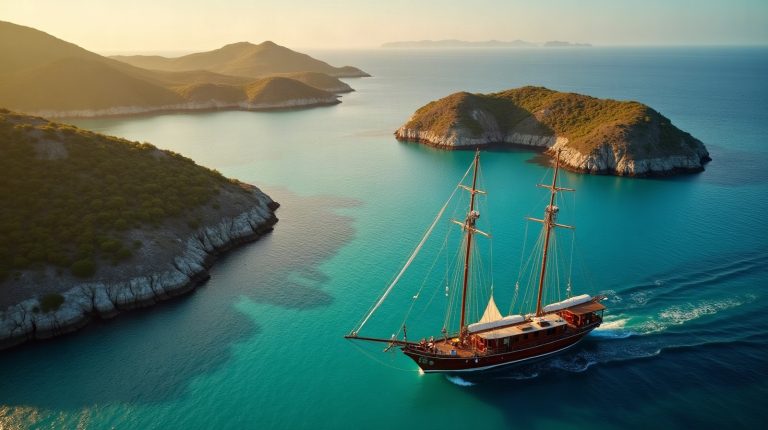
On that leg, the vessel I keep coming back to for people who want it done properly is the Elbark phinisi — 37 metres of ironwood and teak, on the water from October 2022; her nine air-conditioned en-suite cabins lie over three decks and sleep 21 guests when full, twelve-plus crew including a dedicated chef. It cruises at the same seven to ten knots we discussed above, which matters less here because the distances are finally short. Shared three-day, two-night departures leave every Friday from Labuan Bajo, with berths opening at USD 400 and climbing by cabin grade; a buyout of the whole boat begins at USD 8,400 — that is the two-day, one-night run, with a party of up to ten. Departure dates for this phinisi are confirmed by Komodo Luxury, which alone handles her sailing calendar — WhatsApp +62 811 3823 875 or [email protected].
What a Route Planner Verifies Before Booking
Pin these to the chart table before you commit to anything:
- Book the flight first. Denpasar to Labuan Bajo seats sell out in the June-to-September peak; the boat is easier to secure than the plane.
- Match the boat’s rhythm to yours. Shared trips run on fixed departure days — Fridays are common — so build the Bali side of your holiday around the boat, not the other way round.
- Respect the season. April to October is generally the kind window; boats sail year-round, but the wet-season northwesterlies bring more itinerary shuffling.
- Read the exclusions. Park fees, drone paperwork, tips, and flights are rarely inside the headline price anywhere in this fleet; ask for the full invoice picture before paying a deposit.
- Accept the weather clause. Every reputable operator reserves the right to reorder stops for conditions. A skipper who promises you a fixed itinerary in these straits is telling you something worrying about their judgement.
Sail Bali’s waters from Bali and Komodo’s waters from Labuan Bajo, and let an aeroplane do the tedious bit in the middle. It is less romantic than the single blue line across the chart — and it is how the people who know these seas actually do it.
For the full picture, see our recent report: The Bali-Komodo Crossing, Honestly Reviewed: Multi-Day Sailing in 2026.